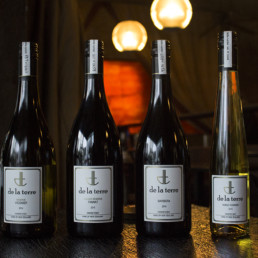
De La Terre Chardonnays
One Variety, One Region, Several Wholly Different Wines
A note from this blog writer: I started at Dhall & Nash in 2015 (I’m well and truly part of the furniture now,) and one of the first tasks I was given as a newbie in marketing was to help organise the launch of De La Terre into our portfolio. Being the first brand of our quite extensive portfolio that I got to work with in any depth, I’ve got a real soft spot for this producer in the Hawke’s Bay. Tony, Kaye and the winery dog, Gracie, are a real pleasure to represent and offer some of the most hands-on, passionate kiwi winemaking there is. Please enjoy.
New Zealand winemakers are pretty special people. For the most part, they’re your classic number-8 wire folks that know their land and their wines like the back of their hand. Many rock swannies and redbands as they work amongst the picturesque vineyards producing wines of world-class calibre.
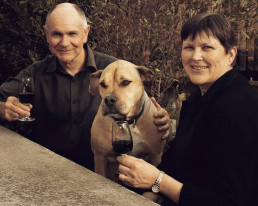
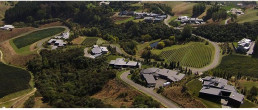
Tony Prichard is one of these kiwi winemakers – rooted in the Hawke’s Bay, he and his wife Kaye have set up De La Terre, where they produce small volumes of high quality wines with the emphasis on elegance, texture and balance.
We’ve covered De La Terre before if you fancy reading more about the big picture, so today we want to knuckle down into the nitty gritty of some of their most popular wines – their Chardonnays.
De La Terre makes a range of Chardonnays alongside their other interesting bottlings, and who better to explain than Tony himself?
Tony always sends us such in-depth and compelling descriptions of his Chardonnays that it feels a crime to gatekeep them, so without further ado, here it is from the man himself in all its glory.
De La Terre ‘Mark I’ Chardonnay
Current vintage at time of writing: 2024
‘Mark I’ Chardonnay is a very important wine for us. It used to be just de la terre Chardonnay or de la terre Estate Chardonnay – our entry-level Chardonnay.
Unlike all our other Chardonnays, it never really had a definitive style or personality – it basically fell out of the bottom after I had blended all the higher priced Chardonnays. In 2024, Kaye and I decided to put more focus on this wine – give it a distinct personality and a name.
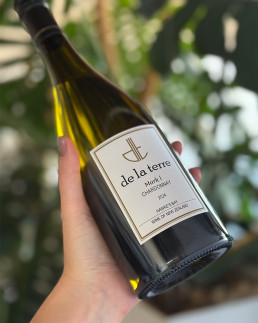
The style we decided upon was specifically targeted at the type of Chardonnay drinker who is out at the local pub or everyday restaurant and wants a nice bottle of Chardonnay that doesn’t break the bank. Basically, the type of drinker who would normally go for the likes of “Fat & Sassy” Chardonnay or similar.
However, the key to this is providing something at this price point that this type of drinker is likely to appreciate and understand.
We aren’t aiming at a sophisticated, long-ageing, elegant Chardonnay here – simply one with an easily-recognisable flavour and aroma profile with non-aggressive acidity and a bit of mid-palate weight. Also, we wanted to develop a style that we can replicate reliably from one vintage to another – the aim being that the customer gets to see the wine as consistently reliable.
With all that said, the style I have gone for is basically a rich mocha character (from fine toasted French oak) off-set with markedly tropical notes alongside the oak. I’ve intentionally tried to keep the acidity reasonably low so the wine is seen as ‘approachable’.
Note: There are 2 things I would now have done differently to the 2024 Mark I – I would have;
- (i) dropped the acidity a touch further and
- (ii) created a bit more mid-palate ‘fat.’
Both these things I have addressed in the 2025 wine – but retained the same overall flavour profile. I have one more trick up my sleeve that I may use on the final blend of the 2025 Mark I – but I’ll keep that to myself for now.
The wine is a blend of oaked and unoaked components (barrel fermented and tank fermented). It is also a blend of Chardonnay clones and areas (Havelock North and Ngatarawa Triangle). Different pressing regimes are also a critical part of this type of Chardonnay – as was the use of different yeast to drive the savoury versus tropical notes in the aroma and flavour.
I would have to say that I am completely comfortable with the initial 2 vintages of this wine. I feel that we managed to hit the style brief fairly accurately – now it’s just a matter of fine-tuning and taking into account any vintage variations that nature may throw at us.
These days, we have quit our Hill Country Estate vineyard and have chosen to focus on Chardonnay (including Methode) and Syrah (also Tannat for the foreseeable future). As such, we see Mark I as an extremely important part of our overall portfolio.
BTW, Kaye came up with the name ‘Mark I’. As stated above, we felt we wanted to give this wine a proper name to accompany the new style. ‘Mark I’ refers to a neighbour who helped out in the cellar in 2024 – he’s an ex-army Colonel and he loves Chardonnay. He was integral in discussing and developing the ‘pub-style’ of the wine with Kaye and myself. ‘Mark I’ may also be seen as ‘classy’ by some as it is sometimes associated with racing cars etc.
Another fun fact – if the trade are enjoying the 2024 Mark I Chardonnay, tell them to wait until the 2024 Barrique Ferment Chardonnay hits the market – it’s a bloody ripper!!
I’ve actually used a few of the techniques I developed for Mark I to fine-tune the Barrique Ferment…”
De La Terre ‘Barrique Ferment’ Chardonnay
Current vintage at time of writing: 2023
“The stylistic signature for our Barrique Ferment Chardonnay is basically a textural ‘food-style’ wine with emphasis on mouthfeel and layers of aroma/flavour.
While it is fermented totally in 225 litre barrique oak barrels, the wine is not intended to be an ‘oaky’ style as such. Instead, we are chasing the slight rusticity and ‘noise’ you achieve when fermenting in (mainly) seasoned oak barrels rather than the more varietal and fruit-driven characters you get with cooler fermentation of the same juice in stainless steel tanks.
Our intention is to play off the fruit characters of ripe/clean Chardonnay against the savoury notes from a range of winemaking techniques.
As with all our Chardonnays, the fruit is hand picked and whole bunch pressed to ensure maximum control of the juice structure and extraction. The grapes are picked at a specific maturity/ripeness/flavour profile to suit the wine style.
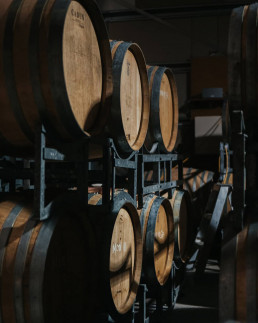
Typically, we ferment in approximately 20 – 25% new and the balance in 3 or 4-year old barrels – mainly French oak but about 25-30% Hungarian as well. The fermentation in mainly older barrels is critical to this style. The characters are markedly different from fermenting in stainless steel, new barrels or even one or two-year old barrels. Most of the overt oak character has been ‘tea-bagged’ out and what you are left with is a porous (to air) and relatively small fermentation vessel with some ‘legacy’ from the previous vintages of use.
To enhance the ‘noise’ in this wine, I ferment very cloudy juice that still contains a reasonably high level of fruit particles – allowing only minimal settling prior to filling the barrels. After yeast fermentation (same yeast every vintage), a portion of the barrels are allowed to undergo malo lactic fermentation to assist with acid balance and mouthfeel.
The wine spends its entire life on full lees (sediment) with regular battonage (lees stirring). This is yet another critical step in defining the style of our Barrique Ferment Chardonnay. Following fermentation and subsequent death of the yeast, the yeast cells break down and release their contents into the wine – creating further layers of savoury and texture.
The wine is bottled, hand-labelled and individually hand-numbered at de la terre.
Summary:
Barrique Ferment Chardonnay
- A complex and textural food style Chardonnay
- Completely barrel-fermented but not intended to be an oaky wine
- Key winemaking techniques to create the ‘rustic’ layers
- Cloudy juice fermentation
- mainly older barriques
- Prolonged time on full yeast lees
We recommend serving this wine at room temperature – and not chilling.”
De La Terre Reserve Chardonnay
Current vintage at time of writing: 2019
“For pretty much all our wines, I start off by writing down a phrase or a few key words to define what I want to see in the glass – i.e. define the style goal for the wine. This gives me a tight focus on how the grapes are handled in the vineyard and what winemaking techniques I use to steer the wine towards this style goal.
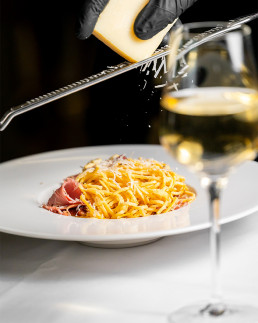
For the Reserve Chardonnay, I modified this concept slightly by using a mental picture of sitting down and drinking this wine with a rich/creamy pasta dish like a Carbonara.
I refer to the Reserve as an ‘old-world’ style of Chardonnay – quite different to the flinty, mineral, lower-oak ‘new-world’ Chardonnays that now have a (deserved) strong presence in the market. Because Carbonara is a rich and robust pasta dish, the wine needed to be full, ripe and creamy-textured.
The grape/juice concentration needs to be strong so we tightly control the grape yield in the vineyard to ensure each berry has a strong innate fruit concentration (typically less than ~1.5 kg/vine). Furthermore, it needs to have a ripe, stonefruit flavour profile so we always harvest grapes at the riper end of the maturity spectrum (typically around 24 Brix) – at this stage, the grapes are the colour of ripe hay – golden yellow with occasional bronze-coloured sun spots.
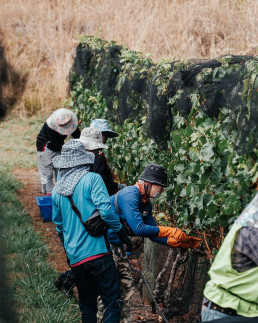
As with all our wines, the fruit is always hand-picked – and at the point of picking, we take a further opportunity to select only the grapes we want for this style. Typically I place markers in the vineyard rows the day before picking so the pickers take only the fruit I want for this style (we take the de-selected fruit for our range of other Chardonnays.)
From the time the grapes are picked, the fruit profile of the wine is largely set. From then on, pretty much all my winemaking effort goes into steering the texture, mouthfeel and balance of the wine towards the rich/creamy style target.
The grapes are pressed very gently, but because we want a rich stonefruit palate, I take a slightly higher press cut than say for my ‘new-world’ style Chardonnay which we call EVB.
Why press slightly higher for this style? – because a lot of the flavour lies in the Chardonnay skins – so it’s a fine balance between getting the flavour profile you want versus over-pressing and extracting coarse/astringent characters. Because this is wine designed to work with strong/rich food, it needs to be powerful to compete. A slightly higher press achieves this.
Furthermore, because we are targeting an inherently stonefruit flavour spectrum , I intentionally allow some passive oxidation of the juice in the press tray. Why – because even a small level of juice oxidation is sufficient to destroy the flavourless varietal thiol precursor flavour compounds in the juice (varietal thiols are the flavourless juice chemicals that famously drive the tropical flavour/aroma of Sauvignon Blanc and are also present in Chardonnay grapes).
By removing the tropical characters, it exposes the more stonefruit-like flavours of the Chardonnay and allows these to dominate.
The juice receives only a very coarse racking before filling into barrels. Why a coarse racking? This is a largely textural and complexity thing. By leaving a lot of the grape solids in the juice for fermentation, you create a richer and more creamy texture and also develop some slightly more complex flavours than you would otherwise achieve when fermenting the same juice which is much less cloudy.
A signature technique for this wine is to ferment it completely in French barriques – 50% of which are new and the remaining 50% in a mixture of 1 or 2-year-old barrels.
I use the same yeast every year for the Reserve Chardonnay for consistency and after fermentation, the wine spends the whole time on its yeast lees with a significant amount of battonage (lees-stirring). Only the (50%) new barrels undergo a malo-lactic fermentation. I use a malo bacteria that is known for producing only a small amount of the butter flavour – diacetyl.
Furthermore, I use winemaking techniques to ensure that the diacetyl produced by malo is largely consumed into (non-buttery) compounds as it ages in barrels. Why? – I use malo principally to help the texture and acid balance of the wine – the last thing I want to see in the wine is an overt ‘buttery’ note dominating the aroma and palate.
The technique of battonage is probably one of the keys to this Reserve Chardonnay. As the yeast dies, their crust/shell splits open and the inner yeast components become part of the wine. Battonage increases the breakdown and release of these compounds from the yeast. These compounds hugely improve the (creamy) texture as well as imparting slightly ‘nutty’/complex characters. Even more importantly, I believe battonage technique harmonises the three main aroma and flavour elements of this style of Chardonnay – fruit, oak and microbiological (yeast/malo).
My intention here is for anyone drinking this wine not to see it as a fruity Chardonnay, an ‘oaky’ Chardonnay or an overtly complex yeast-driven Chardonnay – and certainly not a ‘buttery’ Chardonnay – instead the aim is for a harmony or ‘bringing-together’ of the fruit, oak and yeast notes.
Because this is largely a textural Chardonnay and is designed to drink with rich food, it is better to serve it at room temperature.
Clean, ripe hand-picked grapes, gentle pressing and fastidious attention to oxygen management post fermentation mean this wine will comfortably age for 10 years or so from vintage. Over time, the stonefruit characters will increase, as will the texture and creaminess.”

De La Terre ‘Mark I’
Chardonnay |

De La Terre ‘Barrique Ferment’
Chardonnay |

De La Terre Reserve
Chardonnay |
| Entry Tier – designed for consistency and easy-drinking. | Mid Tier – designed for emphasis on mouthfeel and enjoying with fine food. | Premium Tier – designed for balance and enjoyment, either immediately or after cellaring. |
| Tropical and mocha notes with mid palate weight and low acidity for approachability. | A rustic, savoury and textural chardonnay with stonefruit and a touch of citrus. | Textural chardonnay with stonefruit notes and a creamy, nutty and complex profile. |
| A blend of oaked and unoaked components (barrel fermented and tank fermented.) | Apx. 20 – 25% new, remainder in 3 or 4-year old barrels – mainly French oak but about 25-30% Hungarian as well. The fermentation in mainly older barrels is critical to this style. | French barriques – 50% new, 50% 1-2 year-old barrels. |
NEW: 'Hen's Teeth' Chardonnay
Current vintage at time of writing: 2024
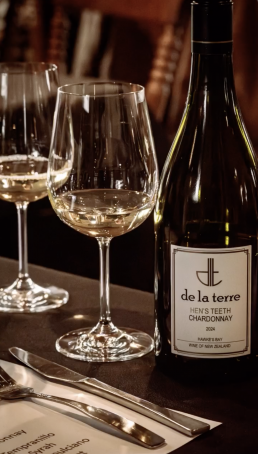
It’s rare as!
“Hen’s Teeth sits at the top of our Chardonnay range.
The Name
The vineyard where the grapes come from (287) was once an old chicken farm – there was talk of the vineyard being named ‘Chook flat’ – thankfully ‘287’ won out!
This wine will only be made in exceptional vintages and only in relatively small quantities – hence the ‘scarcity’ reference associated with ‘Hen’s Teeth’.
Stylistic Aim
A ‘New-World’ Chardonnay, richer and riper in its fruit profile than EVB but not as broad and fat as our Reserve. The wine is all about the grapes and expressing the terroir of vineyard 287. A range of aromas and flavours from ripe grapefruit through white nectarine and white peach with obvious tertiary characters from wild yeast and toasty French barriques. Although 100% barrel fermented in French barriques, we have intentionally kept the new oak level down at 20%. While drinking well in its youth, this wine will reward careful cellaring for at least 10-12 years.
- 100% clone 548 (small-berry clone).
- Grape source – vineyard 287 in Havelock North
- 2024 was an extremely good vintage!
- Very low crop yield/vine (~1.2-1.5 kg/vine) giving strong concentration
- Harvested at 23 Brix to drive the flavour more in the stone fruit spectrum whilst retaining crisp/fresh acidity and a touch of grapefruit/thiol.
- 100% wild yeast cultured from vineyard 287 using the ‘Pied de Cuve’ technique
- 100% malo but managed to deliver low/no buttery characters
- Barrel fermented in 100% French barriques but only 20% new oak
- Designed for very long ageing (10-12 years easily) and strongly rewards time in the bottle
- Works with a wide range of white meat and fish dishes.
NEW: 'EVB' Chardonnay
Current vintage at time of writing: 2024
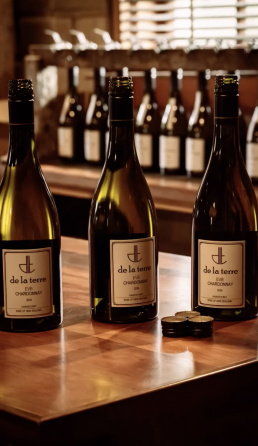
‘EVB’ is simply the initials of a good friend of ours who helped me lay the mud-bricks when I originally built de la terre winery. We actually named the very first Chardonnay produced by de la terre as ‘EVB Chardonnay’ as a thank you to him. We simply decided to carry the name on here.
Stylistic Aim
A ‘New-World’ Chardonnay aiming for powerful concentration with a definitive acid tension in the palate attack. A tighter, more citrus/mineral-based aroma and flavour profile than the ‘riper/fatter’ Chardonnays in our range.
Tight, linear, ‘flinty’, mineral with complexity/savoriness from the wild yeast fermentation. Lots of interwoven layers unburdened from overt new oak dominance. Here, I basically went about making the kind of Chardonnay I prefer to drink myself.
- 100% Mendoza (small-berry clone).
- Grape source – Vineyard 287 in Havelock North
- 2024 was an extremely good vintage!
- Very low crop yield/vine (~1.2-1.5 kg/vine) giving strong concentration
- Picked early (~20.5 Brix) for intentionally higher acidity and high Thiol concentration (grapefruit/citrus rather than broad stonefruit)
- 100% wild yeast cultured from vineyard 287 using ‘Pied de Cuve’ technique
- 100% malo but managed to deliver low/no buttery characters
- Barrel fermented in 100% French barriques but only 15% new oak
- Designed for very long ageing (10-12 years easily) and strongly rewards time in the bottle
- Works with a wide range of cuisine – especially salt-rich dishes
WILDCARD: 'Reserve' Viognier
Current vintage at time of writing: 2018
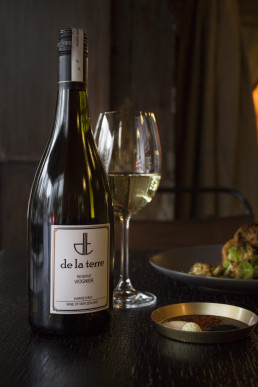
I refer to this as ‘Viognier for Chardonnay lovers.’
Stylistic Aim
It is (intentionally) barely recognizable as Viognier. A style principally designed to work with food. A long, linear structure and complexity-driven aroma/flavour profile as distinct from the normal Viogniers which are typically fruity with quite a broad/’fat’ mid-palate.
- Fruit from our Hill Country Estate vineyard up on Te Mata Peak in Havelock North
- Very low-yielding vines situated on a very steep terrace. We intentionally keep the vines under stress to ensure low yield/vine and a ‘distorted’ Viognier flavour profile
- Whole-bunch pressed very gently to produce a tight/linear juice structure with real length. Here, I basically use the same pressing regime as for a Methode.
- Very cloudy Juice goes straight to French barriques for fermentation – barrels have typically had 6 or 7 previous ferments through them.
- I am not looking oakiness from these barrels – rather the ‘noise’ and rusticity you get fermenting in this older oak compared to a stainless steel tank (or new French barrels).
- Fermented with a Burgundy-isolate Chardonnay yeast.
- No malo.
- After fermentation, the wine spends its whole time (total ~ 11 months) on full lees to encourage further complexity and improved palate texture.
“Alongside Hen’s Teeth and EVB Chardonnays, I rate Reserve Viognier as one of de la terre’s top white wines.”