Waiheke – The New Bordeaux? NEW Red Blend from Stormwood
We’re really proud of our New Zealand winery whānau – from the Bay of Islands to the southernmost vineyards in the world in Central Otago, our corner of the world punches above its weight and is well represented from top to tail in our portfolio, but always with one little niggly gap we’ve wanted to fill… Waiheke Island.
Our own local “Island of Wine” is close to us Dhall & Nashians and we’ve enjoyed daytrips there, visiting customers and entertaining guests who’ve all been wowed by the offerings this little gem produces. The island is a newcomer in the world of wine having only really started its viticulture journey within the last 45 years, but it’s making waves internationally nonetheless and we’ve been particularly privy to watching its rise given our fortunate proximity.
All in all, we’re thrilled to have finally found the perfect Waiheke winemaking partners in Stormwood – a two-man one-dog winemaking team ready to slot right into our portfolio.
Waiheke Island - The Island of Wine
Dubbed “The Island of Wine” this 92km² island in the middle of the Hauraki Gulf in Auckland is world renowned – particularly for their French-style red blends, but with just 216ha of vineyard plantings (just 1% of New Zealand’s plantings) divided between around 30 growers, they’re seriously hot property.
The Dirt
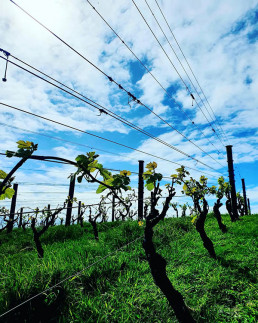
Auckland is an incredibly volcanic region (53 volcanic cones and craters!) and Waiheke is no exception – the eastern side of the island is the remains of a Miocene volcano that erupted around 15 million years ago (give or take a couple…), and the western side of the island was once heavily damaged by the eruption of Rangitoto 600 years ago.
What does this mean? Interesting soil and rocks! A 2006 Auckland City District Plan noted “The natural environment is still a very important facet of the character… there are two valued geological sites on this coast. One is an argillite outcrop in Omiha Bay and the other is a chert stack at the end of Pohutukawa Point, which has one of the best exposures of folded chert in Auckland City.”
The official Waiheke Wine website describes the underlying rock as “a major factor, if not the major factor in determining varietal variations in different terroirs.”
They go on to explain, “With several significant exceptions, most of the islands’ vineyards are separated only by thin layers of soil and clay from massive sequences of Jurassic strata that range from 145 to 158 million years in age.
The uppermost levels of the weathered rock (‘rotten rock’) are generally composed of a stiff to hard soil, often criss-crossed with mineralised veins and stained with iron and manganese oxides.
Though Waiheke is small in area, the age and chemical constitution of the base rock under our vineyards can change markedly and abruptly, even in very small distances. Site variation is enormous, but generally, Waiheke vineyards are highly mineralised but naturally low in pH and phosphate with a high porosity but low permeability. Exceptions occur in gully floors where richer alluvial soils congregate and in the volcanic ash soils at the eastern end of the island around Stony Batter.
The multi-faceted hills created by the early upheaval of the land lead to further variation in vineyard aspect vis-à-vis sunlight and wind which, together with rainfall, have a strong influence on the choice of grape variety.
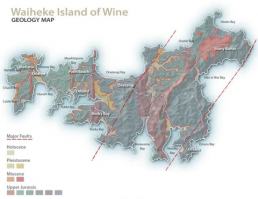
An examination of the geological map of Waiheke Island reveals that the rock strata has been enormously compressed and fractured by tectonic activity causing the landscape to be massively deformed by a series of compression folds whose axes run more or less North and South. Plotting the location of vineyards relative to these formations and their resulting mineral sediments and deposits will reward the wine connoisseur in search of unique varietal expression.”
Wendy Narby for Insider Tasting notes a similarity that perhaps explains why this special wee region excels in producing traditional French red varietals, “The terroir is a mineral rich, montmorillonite clay (not dissimilar from the blue clay at Petrus in Pomerol) over volcanic bedrock.”
Wendy Narby for Insider Tasting notes a similarity that perhaps explains why this special wee region excels in producing traditional French red varietals, “The terroir is a mineral rich, montmorillonite clay (not dissimilar from the blue clay at Petrus in Pomerol) over volcanic bedrock.”
The Climate
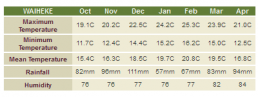
The North Island of New Zealand has a mild climate. NZ Wine Pro describes the climate as “a warmer, drier growing climate than its mainland counterparts.” They further explain, “The growing season is long as a result, and the island’s temperatures are kept at a reasonably moderate level by the ocean breeze, which serves to lessen the temperature extremes allowing for a more gradual transition from summer into winter.”
These attributes class Waiheke as having a “subtropical climate” (Trewartha climate classification,) or an “oceanic climate” (Köppen climate classification.)
Waiheke’s History
Ancient
Aotearoa New Zealand may not be an ‘old-world’ country, but this whenua holds the tales of many. No phoenicians or romans, but truly unique kiwi connections.
Waiheke was settled by the indigenous Māori population in their “Archaic period” (1300-1500) and were visited by some of the great voyaging canoes (waka) by which Polynesians migrated, including Aotea, Tākitimu, and Mātaatua.
The island sustained permanent populations, and the original Māori name for Waiheke was said to be Te Motu-arai-roa, ‘the long sheltering island’, but at the time the first Europeans arrived it was known as Motu-Wai-Heke, ‘island of trickling waters.’
Recent and Vinous
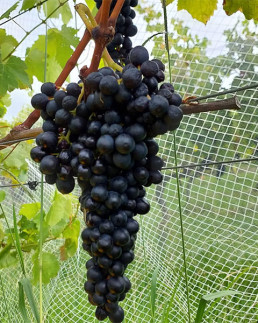
Wine is a very new endeavour for Waiheke – officially the dabbling started in just the 1970s, well within living memory for a lot of people. Waiheke Wine says, “The Goldwaters were the first to introduce v.vinifera, putting in their first vines on Waiheke in 1977 and moving permanently to the island in 1983. They were followed by Stephen White at Stonyridge in 1982…”
1987 was a key year for Waiheke, when Stonyridge’s third vintage of their ‘Larose’ won the trophy for best Bordeaux style blend in New Zealand and was hailed as the greatest red wine ever to be made in New Zealand. Waiheke Custom Wine Tours believes the wine is still holding up, “The 1987 vintage of Stonyridge Larose was such a huge step forward in the quality of NZ Bordeaux blends that it immediately put Waiheke Island on the wine producing map. I last tasted the 1987 vintage in 2017 and it was still very much alive showing just how long well-made wines from the island can age.”
“Anybody who has seen 1987 Stonyridge Larose in a blind tasting of the 1986 classed growth Bordeaux will know that Waiheke Island can make Bordeaux blends of world-class, and even of better classed growth standard. And in this visit too, and the subsequent blind tasting, the best wines again showed a delightful comparability of style to the Medoc or St Emilion.”
– Geoff Kelley Wine Reviews
In the 1990’s, Waiheke Winegrowers Association Inc. was formed to protect the growing reputation and secure the good name of Waiheke wine, and in 2003 the industry started to really pick up, thanks to increased transportation services. Ferries servicing the island got faster, more efficient and more frequent, so the tourism element that had always existed somewhat started to flourish, with the wineries setting up cellar doors and restaurants.
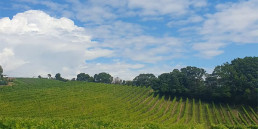
These days, Waiheke is booming. It hosts over 900,000 visitors annually, many of which come to tour the vineyards in a variety of different ways. On TripAdvisor, the top 3 out of 4 featured “Must-Do Experiences” are wine tours and 8 of 10 “Top Attractions” are vineyards.
“So much for the technical, the real reason to visit is the island is gorgeous. Vineyards are often in beautiful locations, but in Waiheke you can add an ocean back drop to rolling vines. With just 216 hectares under vine, and 30 growers, winegrowing on Waiheke is ‘boutique’. Quality and the loyal following this creates ensures economic viability driven by wine tourism that offers a warm and relaxed welcome and innovative hospitality.”
Wendy Narby, Insider Tasting
In 2023, Man O’War was included on the World Best Vineyards annual ranking, a first for the region and surely one of many to come.
Introducing Stormwood
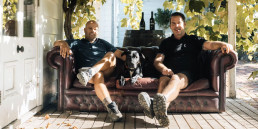
Which brings us to our little corner of the wonderful world of Waiheke – Stormwood.
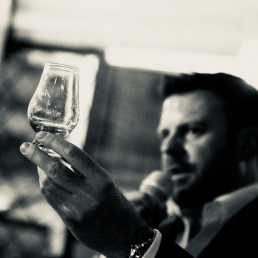
The faces of Stormwood Wine are Waiheke Island winemakers Heinrich Storm (short, stocky, bald – on the left), and Michael Wood (tall, dark, handsome, grumpy, great hair – on the right) (descriptions provided!) and Nui the wonder dog – site foreman, who keeps these two on track.
Stormwood Wine is not necessarily an ‘estate’ but instead a project that draws upon the winemakers’ connections and local expertise. They have been making wine together for over 12 years, and collectively, have over 30 years of experience between them making wine on Waiheke Island. They foster key relationships with growers and landowners to obtain the best parcels of grapes every vintage as a sort of passion project alongside their other notable roles.
“Heinrich also shared the collaborative nature of the wine business on the island, it’s small, everyone knows each other. He works with winemaker Michael Wood, to produce Stormwood.”
Wendy Narby, Insider Trading
The two winemakers also work together at Māwhitipana Ridge Estate – they certainly cover some serious ground.
Heinrich Storm
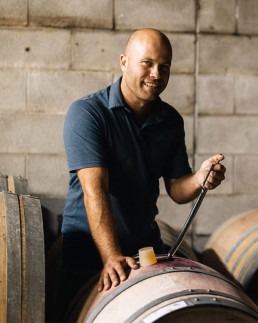
Originally from South Africa, Heinrich has both a really cool name and some serious winemaking credentials. He first became interested in wine while studying hospitality at AUT in the early 2000s, where one of his lecturers happened to be Master Sommelier Cameron Douglas. “It was his passion for wine which really struck a chord to make me want to pursue a career in the wine industry,” Storm told Restaurant and Café.
Heinrich is from a longstanding and renowned pioneering Waiheke vineyard, Goldie Estate – formerly owned by The Goldwaters who were the first to plant vines on the island. He has been making wine there with a particular emphasis on sustainability since 2008.
Speaking to M2 in a profile in 2018, Heinrich explained that the Goldwaters that originally planted the first vines on Waiheke were probably drawn to do so by sheer Kiwi spirit, “As an expat South African I wasn’t familiar with the no.8 wire concept, but I can surely appreciate that sort of Kiwi ingenuity or that Kiwi spirit of adventure… We have received numerous awards for our Syrah’s in recent years which we are very proud of, however what I cherish the most is the great people I work with every day. We have some great camaraderie and friendships on Waiheke Island.”
Michael Wood
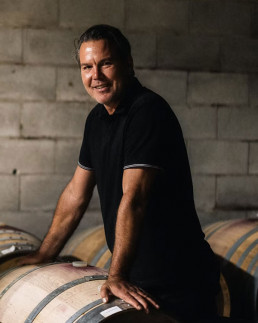
Mike hails from one of the island’s ultra-premium producers, Obsidian Vineyards and also makes wine for Te Rere and Eventide.
Mike cut his winemaking teeth in Germany and Australia, working for Weingut Heitlinger and Mudgee, NSW for Simon Gilbert Wine Services and formalised his training in Blenheim, completing his diploma in Viticulture and Wine Production in 2000.
In 2017, Michael won the prestigious title of New Zealand Winemaker of the Year at the NZ Aromatic Wine Show after showcasing three wines, the Obsidian Reserve Syrah 2015, The Mayor 2013, and The Obsidian 2015.
“I think the wines that have really put Waiheke Island on the map are Bordeaux-style wines, so I decided to enter with cabernet blends that demonstrate what Waiheke is capable of producing,” he told Beck and Caul.
Nui the Dog

He’s really cute, and a very good boy.
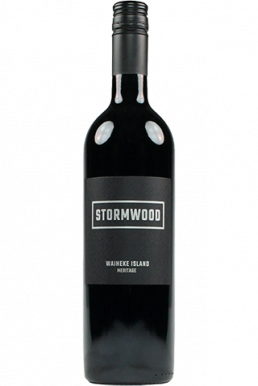
2022 Stormwood ‘Meritage’
2022 Stormwood ‘Meritage’
- Oneroa, Waiheke Island, NZ
- Cabernet Franc, Merlot, Cabernet Sauvignon handpicked between 2 – 11 March
- 100% destemmed, vinified separately in open-top fermenters. Fermentation over 3 weeks with twice daily plunging, then pressed to stainless steel tank.
- Malolactic fermentation in 30% new French Oak, then aged 11 months in barrel and blended before bottling.
- 14% ABV / TA 5.7 g/L / pH 3.65 | 144 Cases Produced
Bright purple to the core. Aromatic and elegant, this Cabernet Franc dominant blend revels layers of ripe red berries, subtle herbs and floral notes. Vibrant and refined, showing juicy red berries, supple tannins, and fresh acidity. French oak brings subtle spice and cedar, leading to a long, elegant finish with a savoury edge. Will reward cellaring for up to 10 years.
Vintage: The 2022 growing season on Waiheke Island was widely regarded as exceptional, offering near-ideal conditions. The summer was warm, dry, and settled, with extended periods of
sunshine and minimal disease pressure. Daytime temperatures consistently hovered in the mid-to-high 20s Celsius, while cooler evenings helped retain acidity in the fruit.
Rainfall during the growing season was well below average, with approximately 140mm recorded between December 2021 and March 2022, which was significantly less than the seasonal norm of around 400mm. The harvest began slightly earlier than usual; the fruit was
consistently pristine and concentrated.
No current vintage reviews, but the previous vintage, 2021, was reviewed by Heinrich’s former lecturer and inspiration, Cameron Douglas MS: “93 Points / Excellent: A complete wine with an enticing bouquet of red and black fruits, fresh and baked, plenty of barrel spices and smoky wood the a dry stony soil suggestion. Full-bodied, fruity and dry, a classic style with a core of fruit, tobacco and blackberry, roasted plums and pencil lead, some bacon oak and vanilla, violet and clove. Ageing nice with best drinking from day of purchase through 2030+”