

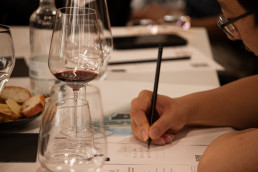
Trade Master Class - The Finest Selection
Join us at the Novotel in Rotorua for the ultimate trade masterclass spanning across all the sections of your wine list, from Champagne, through our newest European wines and into the fortified and non-alcoholic offerings. Hosted by Puneet Dhall, he will be taking you through the following;
Tasting:
- Champagne - Billecart-Salmon
- Cognac - Hine
- Sherry - Fernando de Castilla
- Gruner Veltliner - Laurenz V
- Zaccagnini Abruzzo Wines
- Enzo Bartoli Piedmont Wines
- Oravida Artesian Water
- Pentire Botanical Spirits
This is a free event to the trade and spaces are strictly limited

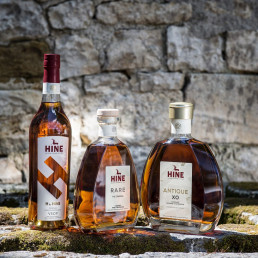
Drinking Hine, Feeling Fine: Second Edition
Drinking Hine, Feeling Fine: Second Edition
In 2019 we brought on Hine Cognac, and released a Cognac 101 explainer blog. Now, seven years on, we revisit it, refresh our knowledge and delve once more into the world of Hine.
If one were to bottle opulence, what would you get? Cognac. Liquid gold. Smooth, amber liquid that blurs the line between wine and spirits.
This fabled creation is revered for good reason among even the most discerning drinkers. Put on a pedestal where whispers of its prestige swirl at its foot – songs are sung about it and no fine bar is complete without it. But what IS Cognac?
We at Dhall & Nash live and breathe wine all day every day so to find something that adheres to all the rules and intricacies within the world of wine, yet sits in a sphere of its own has captivated us.
Cognac 101 - The Basics:
Cognac is a type of Brandy named for the region of Cognac in France. The easiest way to explain it would be that all Cognacs are Brandy, but not all Brandies are Cognac. It must fit strict criteria to be a Cognac rather than a Brandy:
- It must hail from the Cognac AOC (Appellation d’Origine Contrôlée). Just as wines labelled Champagne must be from the Champagne AOC. Source of origin and locality is everything to French winemakers, and this extends to Cognac, too.
- It must be made from a specified grape variety (majoritively Ugni Blanc), that has been distilled twice in special copper alembic stills. The designs of such stills are – you guessed it – controlled by law.
- Once the distillation process has occurred, it must be aged for a minimum of two years in Limousin oak casks.
The Appellations:
The Ins and Outs of ‘Grande’, ‘Fine’, and ‘Champagne’ etc. on the Labels
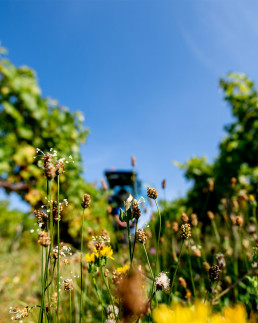
If you’re familiar with French wine, you will be familiar with appellations and the great impact they have on winemaking.
The AOC system was formally introduced in the early 20th century when the Law for the Protection of the Place of Origin was passed. This was to guarantee the authenticity and quality of a product.
They are, in Layman’s terms, specific geographic areas wherein each area has its own set of strict rules that are enforced by law and overseen by a specially appointed government bureau (they take reputation very seriously!). If you don’t follow the rules, you don’t get to use the prestigious label name.
There are seven growing regions or ‘departments’ within the Cognac AOC, sometimes referred to as ‘Cru’.
There are two major players, of whom have (arguably) the highest reputation – Grande Champagne and Petite Champagne. (Side note: these have nothing to do with the sparkling cuvées that are synonymous with the name).
The other five are Borderies, Fins Bois, Bons Bois, Bois Ordinaires and Bois à Terroirs.
Cognacs hailing from the Grande Champagne department (area) of the AOC are considered to be the cream of the crop, followed closely by Petite Champagne. If a Cognac is a blend of these two designations it can be labelled as ‘Fine Champagne’ so long as the portion of Grande Champagne Cognac is 50% or more. Both areas boast shallow clay-limestone, over limestone and chalk.
The Labelling System:
One of the most frequently asked questions about Cognac is “what’s with the labelling system?” There are V’s and S’s and X’s aplenty – which can lead to a lot of head scratching for anyone who isn’t familiar with Cognac and all its intricacies.
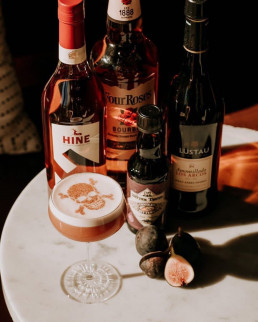
“Cognac will always be associated with the eternal appeal of the timeless – in a world of fine spirits, Cognac is simply finer than all else.”
The good news is, there’s really only four designations of which you need to remember. VS, VSOP, XO and Hors d’âge, and each of them are an indication of age.
- VS: has been aged for a minimum of 2 years. VS stands for “Very Special” and can sometimes be represented as three stars.
- VSOP: Guarantees at least 4 years of aging. VSOP stands for “Very Superior Old Pale” or “Reserve”.
- XO: Until 2018, XO meant a wine was aged for 6 years. It now represents an aging time of 10 years, and the designation “Napoléon” will step in as the label for any brandies aged for 6 years. XO stands for “Extra Old”.
- Hors d’âge: or “Beyond Age”. To be labelled Hors d’âge, the Cognac fits the criteria of an XO, but the term Hors d’âge is often used to differentiate Cognacs that represent an even higher level of quality than an XO.
The best bit about these Cognacs is that the label given to a Cognac is determined by the age of the absolute youngest brandy used in the blending. Even in a VS bottling it is possible that some of the blend comes from barrels aged for decades.
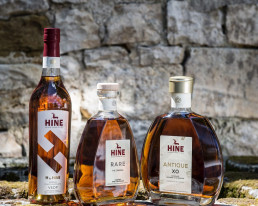
Introducing Hine Cognac
Our little corner of the world of Cognac rests with Hine. While it isn’t quite one of the big wigs like Rémy Martin or Hennessy, it isn’t a small name and definitely shouldn’t be passed by.
Hine was awarded the Royal Warrant in 1962 by Her Majesty the Queen Elizabeth II, and remains the only official supplier of cognac to the British monarchy. Honestly, if it’s good enough for royalty, it’s good enough for us, but its praises don’t end there.
Hine’s History
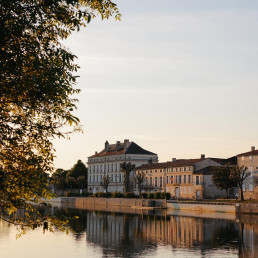
In 1791, one Thomas Hine set out from his home in Dorset, England to learn the ins and outs of how Cognac was produced. He was a mere sixteen years old and curious about what went into creating the copper-tinted brandy his father favoured.
His timing, however, was most unfortunate as he reached France right in the middle of the French Revolution – not the safest place for an Englishman at the time by any stretch of the imagination. After turning on his heels and attempting to high-tail it out of there, he was imprisoned at the Château de Jarnac.
In a strange twist of events, he marries the daughter of the hosts – Françoise-Elisabeth – and in 1817 he retrospectively gave his name to the house which had been established on the banks of the Charente in the Jarnac region in 1763, before he’d even been born.
Since then, the descendents of Thomas and Françoise-Elisabeth have maintained the Hine Cognac House, and six generations have upheld its prestige. They are proud of the fact their cellar door has seen many a year pass by – all whilst being tended by the Hines. Today, Bernard Hine is at the helm, with Paul Szersnovicz as Cellar Master (preceded by the excellent Eric Forget).
The Hine Philosophy
The House of Hine cherishes a solid belief: that a great cognac is above all a great white wine.
“The identity of this wine is imprinted beneath our feet, at the heart of a living land that has evolved over thousands of years. Vines form the link between the earth and the heavens, replete with vagaries and caprices. They infuse the grapes with a character extracted from this unique, unparalleled place, imbued with a temporality that commands the here and now. Cognac embodies a perpetual quest for balance between consistency and virtuosity.”
And it was this philosophy that reeled us at Dhall & Nash in – hook line and sinker. We pride ourselves on our deep respect for the families who work their piece of earth until they know it as instinctively as the back of their hand – it etches itself into the bloodline, and to find this reflected so perfectly in the Hine belief was something that spoke to us all.
“So where does Hine sit in relation to the big four producers: Hennessy, Courvoisier, Martell and Rémy Martin?” Asks Club Oenologique speaking to then-cellar-master Eric Forget, ““Hine is the opposite of Hennessy,” Forget explained. “Hine is elegant, delicate, light and aromatic. But compared with Hine, Hennessy is quite heavy, with a lot of body and power, and rich in wood. In the middle you have Courvoisier and Martell. Rémy is more on the Hine side, as it has the delicacy. People often say ‘I don’t drink Cognac because it burns when I drink it’. But with Hine? Never.””
Add to this the admirable way they’ve maintained a real essence of ‘cool’ that keeps up with modern times and remains approachable and fun, whilst marrying this with a real seriousness and respect for tradition and history. It’s rare for a brand to transcend these rather demographic-defining boxes and become a voice for both new generations of cognac-lovers and loyal veterans of the prestigious tipple.
Acclaim
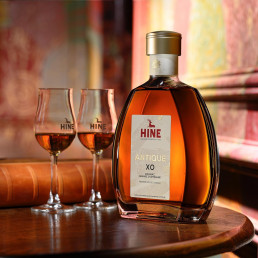
As well as our word, and that of Her Majesty the Queen, there are plenty of critics who sing the praises of this House as well. Jason Wilson for Vinous has published a piece detailing his love and exploration of Cognac. In this he says,
“…For this report, I’ve pushed beyond the Big Four, beyond the flashy and expensive, and tried to bring you a broad sense of what’s really happening in Cognac. I have covered more than 50 brands and offering reviews and ratings on more than 200 bottles. I found value and quality among medium-sized producers like Frapin, Hine, Braastad-Tiffon, Pierre Ferrand, Delamain and Bache Gabrielsen, among others.“
The Guardian, too, listed it among the top ten distillers, tours and tastings.
Hannah Crosbie for Berry Brothers & Rudd writes “What Hine Cognac lacks in size, it more than makes up for in quality,” in her piece “Hine: “the future of Cognac”, “Hine is not a Cognac house with a mile-long driveway or ostentatious signage, nor does it want to be”, she explains. “It’s where a young Eric Forget arrived in 1999 – a stark contrast, surely, to his time at Hennessy.
“The thing that immediately surprised me was how much less Cognac Hine made,” Eric recalls. “But I soon realised that it’s because we are so focused on quality. We’re working with very small batches to get single casks of the very finest eau de vie. In this way, I sometimes feel like a parfumer, or like I work in haute couture.””
88 Bamboo (who writes some seriously good blogs we thoroughly enjoy, we must note,) poses that “Hine Cognac has quite the streak of doing something no one else does – and yet somehow does so in a way that seems to only subtly demonstrate just how great a grasp they have on what makes Cognac special… Hine [has a desire] to bring its Cognacs closer and more distinct to its fans. Here it’s all in the subtlety and the precision – call it quiet elegance and deft mastery.”
A New Approach
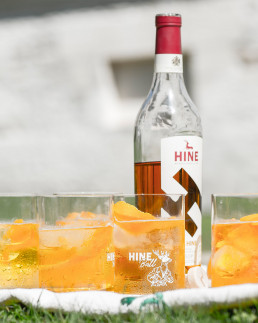
Mentioned a few times is Hine’s ability to broach the gap between generational drinking trends. For many of the more mainstream names, this would be a very “How do you do, fellow kids?” move. Newer generations don’t want to be drinking the same stuff their grandparents were drinking – whether it was good or not.
One scroll down Hine’s bright, modern, funky and interactive website tells you right off the bat this isn’t a dusty old brand, even if it is, well, an old brand.
“Try something new, especially if it’s 260 years old” is the bold statement that introduces you into the world of Hine.
This juxtaposition is everything to Hine. Their product is the result of centuries of careful and mindful craft and tradition but their approach once it leaves the cellar looks forward, not backwards. It asks what the drinkers of today want from their Cognac, not what the drinkers of the 20th century want. It’s a new world, they want in, and they have the expertise and product to do it.
“In the world of Cognac, Hine means to shake things up,” explains Luxury Society. “Hine is on a new mission to shake up the world of cognac by attracting younger, experience-led consumers to its cognac brand, starting with a radically different brand expression and bold communications strategy…Gone are the days of middle-aged men in padded jackets, smoke-filled cigar rooms, sitting on leather Chesterfield sofas in panelled wood rooms…”
The Cognacs:
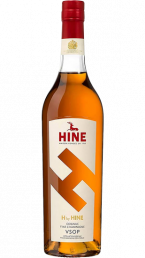
H by Hine VSOP
The Flagship
- V.S.O.P. (Guarantees at least 4 years of aging for the youngest component)
- Cognac Fine Champagne (From Grande & Petite Champagne Only)
- Double distillation on lees
- Aged in light toasted, fine-grained oak
Adventurous, lively and elegant, H by Hine shows notes of Iris, fresh apricots and white pepper.
“This cognac was created 20 years ago by Éric Forget, my predecessor, in collaboration with American and British bartenders. Its finesse, delicacy, and floral notes make it a light and perfectly structured VSOP, conceived from the very beginning as the ideal foundation for exceptional cocktails and long drinks.” – Paul Szersnovicz, Cellar Master
88 Bamboo: “Colour: Gold
Aroma: It opens immediately with this sense of agedness and depth, giving all these dried fruits of apricots and dried orange peels, alongside lacquered wood. Following closely is a spread of green grapes and yellow raisins drizzled in maltose candy. It’s really aromatic and fruit driven, with a completeness of both brighter and deeper tones.
Taste: Medium-bodied here with a lively spiciness that’s very satisfying yet not over the top, backed by more of that honey and maltose candy. Waves of green fruit and yellow raisins weaved into the rich body, with also a layer of clove spices. That liveliness still remains incredibly compelling even at this point! It’s not heavy, and yet has a good amount of richness. More on dried apricots, with also a dash of paprika.
Finish: It gets more doughy and floury here, with also yellow raisins and dried apricots, coming together to give something like an unbaked orchard fruit tart. There’s some savouriness here as well, going into that seamless finish.
My Thoughts: I know this was designed for cocktails but boy is it surprisingly good! It’s got great liveliness on the palate, enough to keep it exciting and yet not too much that it tips it over. It’s also really all-rounded and complete with quite a range of flavours that come together nicely, with a mix of brighter and deeper tones. And at the same time it somehow cusps the ability to keep things fresh and yet also feels rather well-aged. I also particularly relished that doughy umami savouriness into the finish that added another dimension to it, just when you thought you got a good handle on it. Perhaps the only thing I’d like to see more of is heft on the body, which comes off a touch lighter than I’d like – but then again, wasn’t this meant for cocktails?”
Vinous, 92 Points: “An average of five and a half years old, and a blend of Grande and Petite Champagne, H by Hine is light amber, with a pretty nose of iris and buttered brioche. On the palate, it’s light and fresh, offering notes of nougat and candied orange, and some wood on the finish.”
Wine Enthusiast, 92 Points: “Concentrated vanilla aromas lead to a bold, dense palate showing peanut butter, vanilla cream and salted caramel. Clove warms the finish, while a lingering floral note lightens the exit.”
Good Spirits News, A++: “H by Hine VSOP Cognac is a blend of almost 15 different Eaux-de-vie from the Grande and Petite champagne growing region… High, fine, keening aroma of grape spirit, oak stave and an almost floral coloration. As impressive in the glass as on the nose, with a shy approach that only hints at what is to come. Some barrel essence comes through initially, but after several seconds, a lovely grape character bursts onto the scene and stays for the duration. A light mouthfeel gives this an airiness and spring-like character that is irresistable. One of the best Hine releases we’ve had the pleasure of reviewing. This is our current “go to” for a nightcap.”
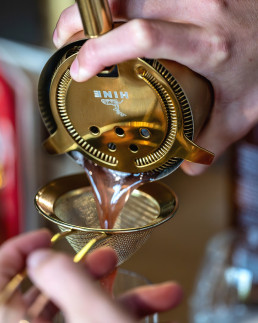
How to Enjoy H by Hine:
With its fruity, floral, and spicy profile, cognac takes cocktails to new heights. It’s a surprising
twist that can switch out ingredients on Manhattans or Mojitos and compliments desserts.H by Hine in particular was created with the help of American and English bartenders, so the Hine team could understand what they needed to bring Cognac into the world of mixology. This means H by Hine is a fantastic cocktail Cognac (as well as on its own.)
See a list of Hine’s Cocktail Recommendations here, including the Hineball, Hine Sour, and the Revivalist.
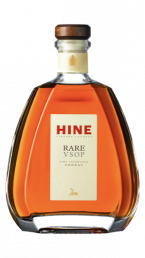
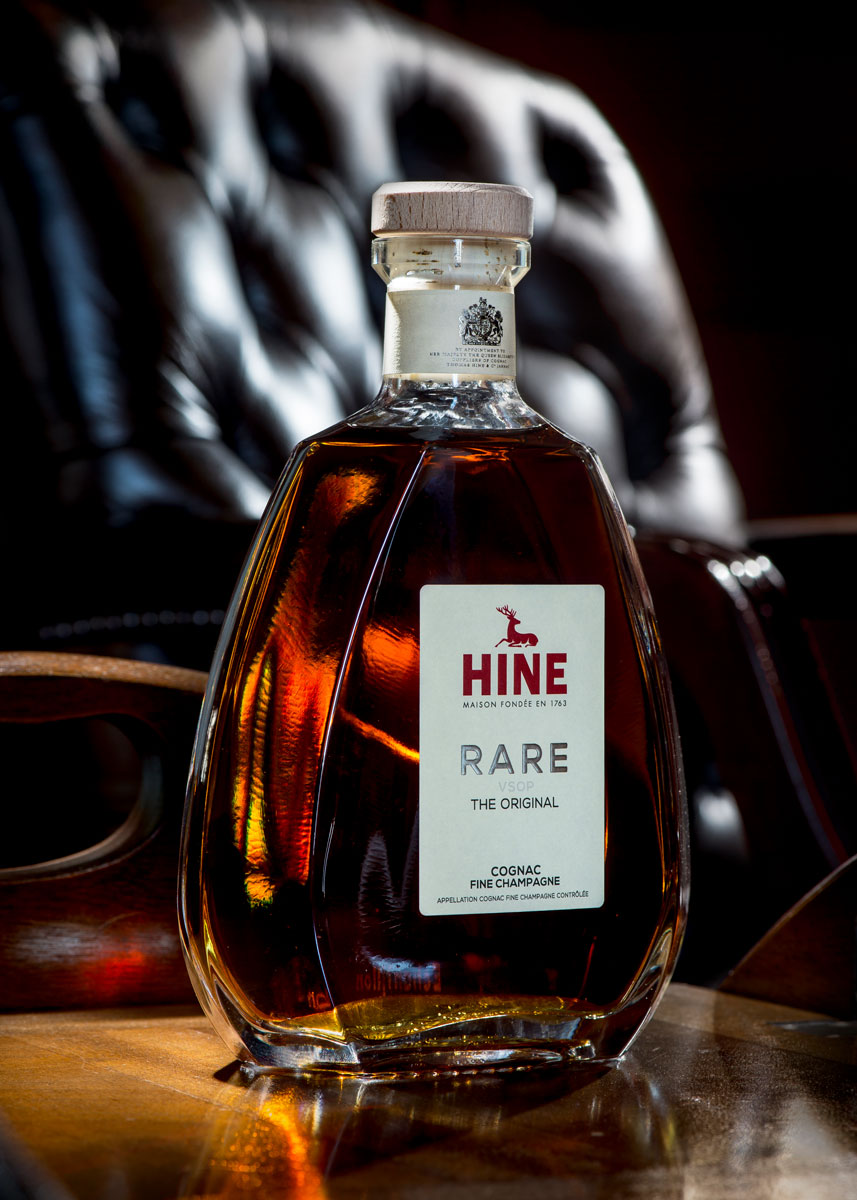
Rare VSOP
Attainable Luxury
- V.S.O.P. (Guarantees at least 4 years of aging for the youngest component)
- Cognac Fine Champagne (From Grande & Petite Champagne Only)
- Double distillation on lees
- Aged in light toasted, fine-grained oak
Fruity, suave and delicate, ‘Rare’ shows notes of apricot, nectarine & melon.
“This blend, created over 50 years ago, is quite unique in the world of cognac. Its smoothness and softness on the palate are remarkable, and it is a cognac much appreciated by all consumers.” – Paul Szersnovicz, Cellar Master
Wine Enthusiast, 93 Points:
“This rich, supple Cognac is a liquid expression of a vintage leather club chair. The nut-brown spirit has big aromas of creme brulee, toffee, cigar tobacco and cocoa. After an initial sweetness on the tongue, it finishes relatively dry with lingering caramel, raisin, leather and orange peel flavors, and a bracing alcohol bite.”
GoodSpiritsNews, A-:
“Visual: Amber.
Nose: Sweet grape, oak, soft leather.
Taste: Rich, deep brandy flavor with a woody, semi-fruitcake flavor. Baking spices, currants, light vanilla bean, tannin at the very end.
Finish: Medium long, with more of the oak keeping on.
Overall: An elegant and smooth cognac that works as a sipper and in cocktails that call for a finer approach.”
88 Bamboo:
“Colour: Deep Amber
Aroma: Really luscious and expressive, with florals, honey and a clear presence of orchard fruits. It opens up with this crystalline note of honey washing over fresh linen that blends into lifted aromas of jasmine blossoms. As it sits in the glass, there’s more layers of freshly sliced peaches, orange supremes, soft dried apricot and some golden raisins, complemented by creamy vanilla pudding. The aroma is rounded and dense, with a clean chalky mineral edge to it that adds some character.
Taste: Immediately bright and lively on the palate, a fresh burst of orange oil and citrus peels that gently unfolds with mellow layers of golden raisins, caramelised bread pudding, and smooth, rich toffee. By the mid-palate, it’s giving lots of delicate European oak notes that provide structure while staying in the background without overstepping the honeyed fruits. Some subtle herbal candy undertones and light baking spices.
Finish: Really long and smooth, carrying through the gentle honey along with an interesting touch of liquorice and Hacks grape candy in all its minty-grapey glory, and then closing with lingering orange peels.
My Thoughts: This showcases both exceptional balance and accessibility by all counts, and also a step-up in its depth and fruitiness compared to the VSOP – the heft we were looking for in the VSOP is definitely found here. And that’s a great base leapfrog off on, considering we liked the VSOP very much already.
It starts off with really expressive and layered fruit aromas, while the palate keeps that same energy with bright citrus and sweet mellow pudding notes. I enjoy its flavourful brightness and vibrant personality, which deftly avoids the pitfalls of becoming overly oaked. The oak is present but mellow and restrained, and yet it still boasts a rather prolonged finish. This expression precisely bridges the gap between youthful brandies and mature Cognacs. It’s an excellent sipping experience richly flavoured but still retaining a really clean, fresh and candy-like lusciousness without leaning too far into too much oak.”
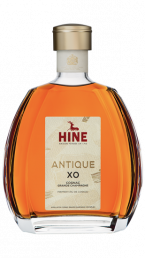
Antique XO
The Big One
- X.O. (Guarantees at least 10 years of aging for the youngest component)
- Premier Cru de Cognac (From Grande Champagne Only)
- Double distillation on lees
- Aged in light toasted, fine-grained oak
Enticing, bright and complex, Antique XO shows notes of ginger, cinnamon and florals.
The Antique XO was replaced in 2024 by a new bottling called simply, ‘XO’. Forbes covered the switch in their piece here, but we are lucky to still have the Antique XO expression in stock. It is made from their highest grade of grapes, from Grande Champagne only and treated ever so carefully by the cellar masters.
Drink Hacker, A-:
“…Notes of nougat and oak on the nose. Bold on the palate, with a rich salted caramel base that hints at coconut, milk chocolate, and red berries. The flavor is really packed in here, but the finish is quite gentle, with a slightly fruity, spicy, and mildly floral character that lingers for ages.”
Difford’s Guide, 5 Stars:
“Appearance: Clear, deep coppery amber.
Aroma: Leather, honey and vanilla with floral honeysuckle and violet. Very delicate spice.
Taste: Dry, delicately spicy and complex with stewed white fruit (peaches and apricots), toffee, fudge, vanilla, espresso and dark chocolate.
Aftertaste: Espresso coffee, fudge, chocolate and mild pepper spice.”
Quill & Pad:
“The Antique XO is not a vintage cognac, but rather a blend of more than 40 different components. It was first created back in 1920. The Hine du jour, George, who created the concept, had nicknamed his old casks as his “antiques,” hence the name…
There is a minimum of ten years ageing here, though the impression is that there might be even more time maturing, such is the balance. The reason for this impression became clear when it was revealed that the average age of the components was 20 years. The oak used in the maturation process is mostly Troncais rather than the more common Limousin. Hine believes that the tighter, finer grain leads to fewer tannins being evident in the finished cognac.
The flavors come in ever-evolving waves. I always make certain I do my own notes before looking at those of others or the producer so as to avoid their influence (it is nearly impossible not to see some of the flavors others claim if you hear of them before tasting – or it is for me).
My immediate impression was of baked apples, and sure enough when I looked at the “official” tasting notes, I was not alone in that. Imagine a baked apple pie fresh from the oven. A whiff of glacé fruits, mild chocolate, nuts, raisins, and figs.
The oak gives up a vanillin, cedary character, which is not intrusive. Lovely richness, fine length, and good balance. Lots of complexity evident in this cognac, which is far more subtle, more delightfully delicate, than many.
Sure, there is plenty of spirit here, but it is so finely balanced that there is nothing harsh or too fiery, leaving a lovely creamy, almost cuddly texture. A really impressive cognac that is a joy to drink.”
All in all, Hine is the best of not just both worlds – but every world. It is a wine, it is a spirit, and it’s good at being both. It is a fresh, bold and slightly cheeky brand, yet remains serious and true to its origins going back centuries. Whether you’re young, old, a whiskey-lover, or a wine-aficionado, an ‘on the rocks’ fella or you like it with a twist – Hine’s got you covered.

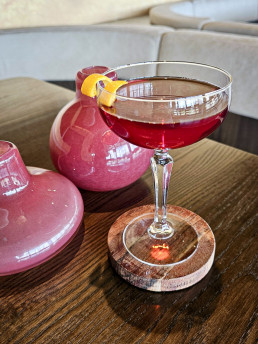
The Debutante
Cocktails & Recipies
The Debutante
By Martin Wood at Seven Dining in Christchurch
Smokey, spicy, dark chocolate-dipped cherries in a glass.
Ingredients
- 45ml 144 Islands Sweet Vermouth #2
- 30ml Wild Turkey Rye Whisky
- 10ml Campari
- 5ml Aged Single Malt Whisky (Ardbeg 10YO)
Steps
- Stir the first three ingredients with ice and strain
- Float the single malt with a barspoon
- Serve in a chilled coup with a maraschino cherry or wedge of orange.
“Smokey, spicy, dark chocolate-dipped cherries in a glass. This is the drink closest to my heart and the one I’d likely order multitudes of. Everything in the glass is there to support the flavours present in the vermouth. The Scotch can be omitted and it still tastes good but the Ardbeg really ties it together. Rich and complex.”
144 Islands Vermouth No.2
Vermouth No 2. by 144 Islands is a red base wine of Syrah. Fortified to 22% abv with grain-based spirit, approx. 190 g/L residual sugar. Kerikeri Navel Oranges, Totara Bark, Pohutukawa, Kauri, Northern Rata, Kahikatea and Matai locally sourced or foraged by hand by owner, Jake and his son Remy. Botanicals macerated in alcohol, then distilled through rotary evaporation and added back to base wine at fortification.
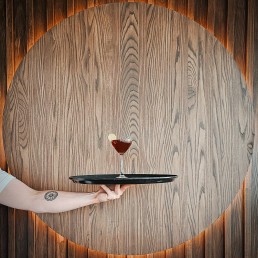
The Harvard
Cocktails & Recipies
The Harvard
By Martin Wood at Seven Dining in Christchurch
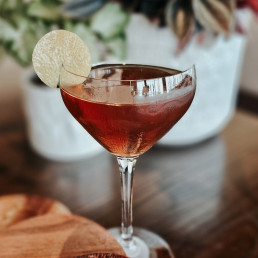
The ‘Harvard’ is a child cocktail of the Manhattan, and works wonderfully to showcase the rich flavours of this vermouth.
Ingredients
- 20ml 144 Islands Sweet Vermouth #2
- 60ml V.S.O.P Cognac
- 5ml 1:1 Brown Sugar Syrup
- 1 Dash Angostura Bitters
- 1 Dash Raegan’s Orange Bitters
- Pinch of salt
Steps
- Stir with ice and strain
- Serve in a chilled coup with a maraschino cherry or thin orange twist.
The ‘Harvard’ is a child cocktail of the Manhattan, and works wonderfully to showcase the rich flavours of this vermouth. The Cognac bolsters the spice and cherry of the vermouth while the vermouth really brings out the rich apple flavours and barrel aging of the brandy. extremely quaffable and it’s basically all grapes. Harmonious and decadent.
144 Islands Vermouth No.2
Vermouth No 2. by 144 Islands is a red base wine of Syrah. Fortified to 22% abv with grain-based spirit, approx. 190 g/L residual sugar. Kerikeri Navel Oranges, Totara Bark, Pohutukawa, Kauri, Northern Rata, Kahikatea and Matai locally sourced or foraged by hand by owner, Jake and his son Remy. Botanicals macerated in alcohol, then distilled through rotary evaporation and added back to base wine at fortification.
H by Hine VSOP Cognac
Six generations of the Hine family have succeeded one another at the head of Thomas Hine & Co. The tasting rooms at 16 Quai de l’Orangerie have seen it all, from the Great French Wine Blight to local conflicts, world wars, first bottlings, international incidents, economic booms and slumps, legendary river floods, connoisseur parties and exalted blends.
H by Hine is whimsical. If it were a young man, it would have the keen eye of Dick Diver in Fitzgerald’s Tender is the Night. A honeyed golden amber. Markedly floral, with a touch of vanilla and apple blossom. Adventurous, lively and elegant. Expressive yet discreet, its notes of iris, fresh apricot, acacia and white pepper chime with its sprightly and joyful demeanour.
It feels like Coachella in a bottle.
The Xmas Spirit: Festive Digestif Wines
We LOVE our fine wines here at Dhall & Nash, yet we also LOVE to indulge in a wee dram of something a tad stronger. That much-needed ‘medicinal’ de-stressor – our hands firmly around a brandy balloon full of liquid amber Cognac or a snifter of glossy Grappa. Ideal to get you through the umpteenth rendition of Jingle Bells or Uncle George’s conspiracy theories! Not to mention they are the most glorious gifts for the friend who has (almost) everything. Indeed, these are ‘silly season helpers’ to ease you joyfully through the holidays…
So, what makes spirits so special in the world of alcoholic bevvies? Here’s a quick look into the magical alchemy of distillation…
While the history of distilling is actually tied to the history of alchemy – yes, we owe liquid confidence to an ancient mystical science – the basic concept of distilling has always been pretty simple: making a harder alcohol from a lower alcohol base.
But why do we have to distill hard liquor? Why can’t we just keep fermenting it to higher and higher ABVs (Alcohol by Volume)? Fermented beverages sit at a much lower alcohol content than spirits, whereas, a typical spirit is 80 proof, which is 40 percent ABV. But as often happens in the science of booze, it’s all about the yeast.
As the yeast eat up the sugars (to make beer or wine, for example) they create alcohol and CO2, delightful waste products. But the more alcohol and CO2 they create, the less sugar there is for them to feed on. And at a certain point (around 14-18% ABV), the alcohol levels become toxic for the yeast. To create anything substantially “hard”, we can’t rely on yeast any further. To get higher ABV alcohol, we have to actually physically separate alcohol from water using evaporation and condensation – aka distilling.
Because alcohol has a lower boiling point than water, distillers can evaporate the alcohol (mostly) by itself, collect the vapours into a tube and use cold temperatures to force the alcohol to condense back into liquid of much higher alcohol content.
For example, when vaporising wine, you take the wholesome middle-cut of the run through the pot still, missing out the poisonous first part and the watery final part, as distillers have learned to do. You then are left with the grape spirit, grappa, eau de vie, or brandy of about 70% ABV.
Now, onto that all-important distillation vessel – Spirits can be made in ‘alembic’ pot stills (where flavour tends to be more important – whiskeys, cognac and similar), column stills (where we want a more neutral flavour, so vodkas, gins, etc.) or using both pot and column stills as a blend, for a sort of ‘best of both worlds’ approach – getting flavour from the pot still, but bulking it out with the cheaper to produce column distilled alcohol.
Many distilled spirits contain colouring ingredients, although the colours of some (e.g. Armagnac, Cognac, Scotch, Malt Whisky, Bourbon, some Rum and others) are derived from a few years’ maturation in oak casks. Yet others, such as Absinthe, certain flavoured vodkas, and some liqueurs obtain their colours from various added flavourings, such as fruit, herbs or spices.
Today the world is going crazy with a bounty of diverse distilled spirits being produced. Overall though, there are just six base liquors that form the foundation of the majority of cocktails and liqueurs. Brandy, gin, rum, tequila, vodka, and whiskey. Each are unique and have distinct styles within themselves. Here’s the basic characteristics of some of these liquors:
Brandy
“When life gives you eggnog, add a splash of brandy”
Also known as Cognac, Armagnac, Grappa, Spanish Brandy, Pisco, American Brandy, Eau-de-vie, these are distilled primarily from grapes, though sometimes other fruits are used like apples (Calvados), apricots, cherries (Eaux-de-vie) and the like. Typically, they are aged in oak, but this varies according to the style or traditions and are quite often blended. The alcohol content is typically 40% ABV (80 proof).
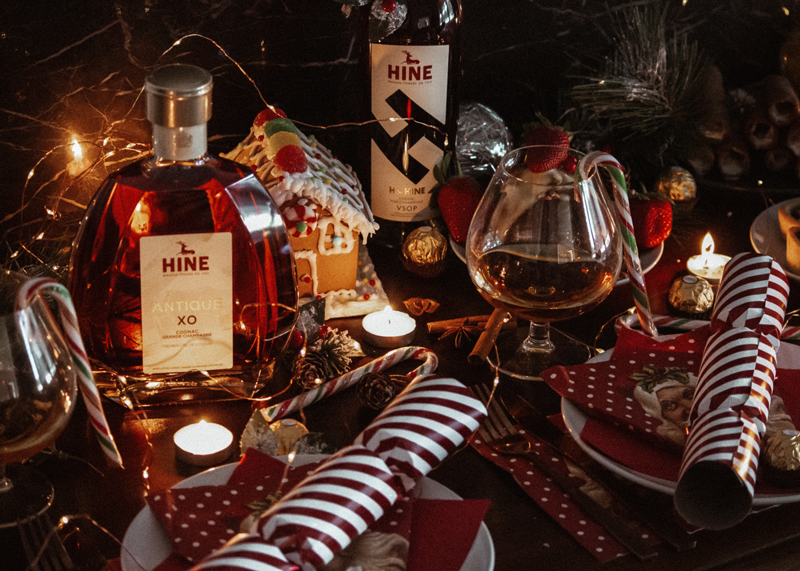
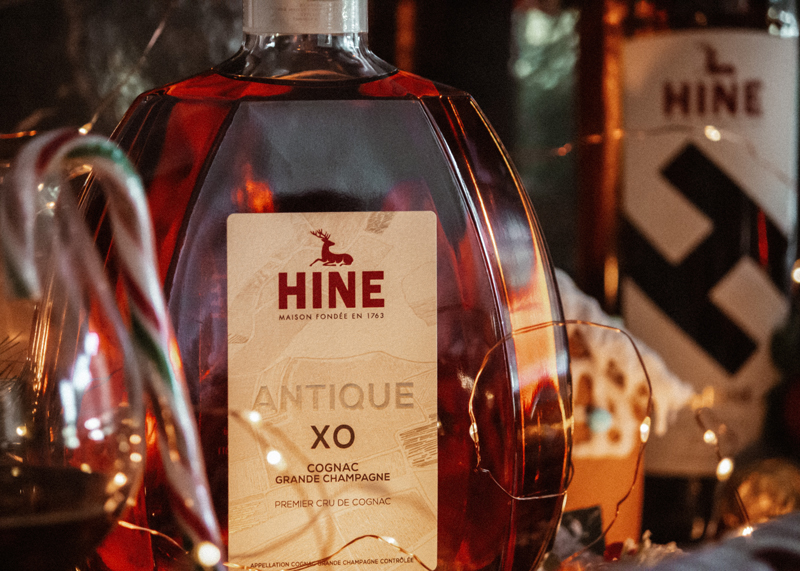
One of the finest of the fine is our Dhall & Nash staff favourite Hine Cognac. This is truly bottled opulence. Liquid gold. As smooth as silk, blurring the line between wine and spirits. This fabled creation is revered for good reason among even the most discerning drinkers.
So, What IS Cognac?
Cognac is a type of Brandy named for the town of Cognac in France. The easiest way to explain it would be all Cognacs are Brandy, but not all brandies are Cognac. It must fit strict criteria to be a Cognac rather than just a Brandy:
Firstly, it must hail from the Cognac AOC (Appellation d’Origine Contrôlée). Just as wines labelled Champagne must be from the Champagne AOC. Source of origin and locality is everything to French winemakers, and this extends to Cognac, too. The AOC system is the ultimate guarantee of the authenticity and quality of a product.
But wait, there’s more – within the Cognac AOC, there are seven growing regions or ‘departments’, sometimes referred to as ‘Cru’. There are two major players, of whom have (arguably) the highest reputation – Grande Champagne and Petite Champagne. (Side note: these have nothing to do with the sparkling cuvées that are synonymous with the name). The other five are Borderies, Fins Bois, Bons Bois, Bois Ordinaires and Bois à Terroirs.
Cognacs hailing from the Grande Champagne department of the AOC are considered by some to be the cream of the crop, followed closely by Petite Champagne. If a Cognac is comprised of a blend of these two designations it can be labelled as ‘Fine Champagne’ so long as the portion of Grande Champagne Cognac is 50% or more.
Cognac must be made from a specified grape variety (mainly Ugni Blanc), that has been distilled twice in special copper alembic stills. The designs of such stills are – you guessed it – controlled by law. Once the distillation process has been completed, it must be aged for a minimum of two years in Limousin oak casks.
One of the most frequently asked questions about Cognac is “what’s with the labelling system?” There are V’s and S’s and X’s aplenty – which can lead to a lot of head scratching for anyone who isn’t familiar with Cognac and all its intricacies. The good news is there’s really only four designations of which you need to remember. VS, VSOP, XO and Hors d’âge, and each of them are an indication of age.
VS: has been aged for a minimum of 2 years. VS stands for “Very Special” and can sometimes be represented as three stars.
VSOP: Guarantees at least 4 years of aging. VSOP stands for “Very Superior Old Pale” or “Reserve”.
XO: Until 2018, XO meant a wine was aged for 6 years. It now represents an aging time of 10 years, and the designation “Napoléon” will step in as the label for any brandies aged for 6 years. XO stands for “Extra Old”.
Hors d’âge: or “Beyond Age”. To be labelled Hors d’âge, the Cognac fits the criteria of an XO, but the term Hors d’âge is often used to differentiate Cognacs that represent an even higher level of quality than an XO.
The best bit about these Cognacs is that the label given to a Cognac is determined by the age of the absolute youngest brandy used in the blending. Even in a VS brandy it is possible that some of the blend comes from barrels aged for decades.
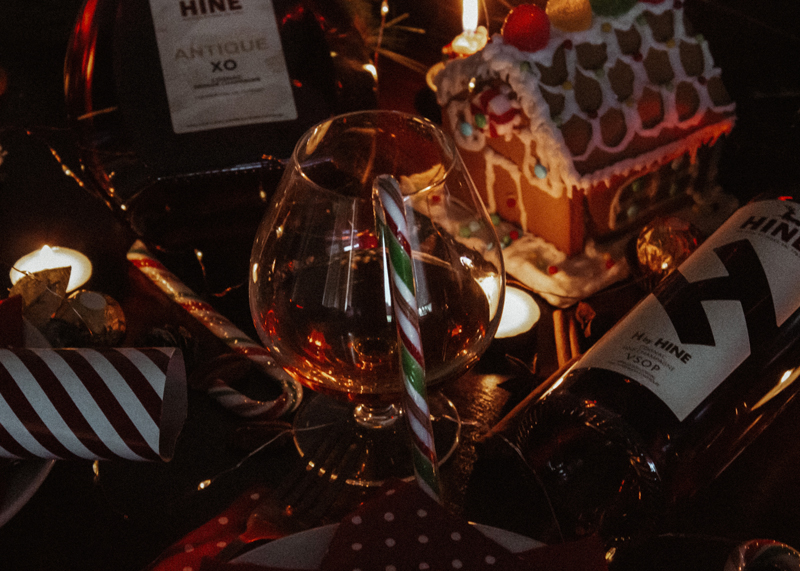
For however much we would love to sip an XO after our lavish Xmas dinner, don’t forget to have some fun with the young cognac “H” by Hine – the obvious one is to up the ante and put it in your festive eggnog or on Boxing Day serve it frozen in a shot glass. Or simply over ice with tonic, cider or ginger ale, garnished with a twist of lime, cucumber or rosemary… Go wild!
Grappa
Another fine example of a Brandy/Eau-de-vie style is Italian Grappa.
We’ve got you covered here at Dhall & Nash with the exquisite Sartori Grappa di Amarone della Valpollicella. Supple, smooth and touched by floral notes with hints of raisins and dried fruits. There’s nothing better than a little glass of quality Grappa to aid the digestion at the elegant conclusion to a lusciously languorous Xmas meal. After all, as they say in Italy: “one devil drives out another”!
So how is Grappa made? Traditionally, it is made from pomace, that is, discarded grape seeds, stalks and stems that are a by-product of the winemaking process. This is the perfect example of a ‘zero waste’ product. The pomace is combined with alcohol, then heated. This allows the mixture to separate, leaving behind a super potent beverage that is bottled and aged for a minimum of 6 months or in the Sartori Grappa di Amarone’s case, 24 months.
Admittedly, Grappa did have a bit of a bad rap initially. When producers first began making it, they took a “mix-and-match” approach and used a blend of pomace from a variety of grapes. It certainly did earn its “firewater” moniker in those days. Then in the 1960s, producers began experimenting by making it with a single grape for a higher quality drink and in some cases adding sugar or herbs for a less intense but more refined flavour.
Today, the world renown digestivo Grappa is a protected name under European law. In order to be called “Grappa”, it must be produced in Italy and made entirely from pomace following a specific distillation method. And absolutely no water can be added!
Grappa can be transparent, golden or brownish. As exactly like for wine, the taste depends on the grapes used to make it, and on the ageing. If aged in wood barrels, the colour turns light gold or darker, and it gets a slightly vanilla taste.
How is Grappa served in Italy? Basically, the best Grappa is savoured sipped from small glasses. But you’ll see in every café the locals add it to their coffee to make caffè corretto (which literally means “corrected coffee”). If you don’t like to mix your coffee with Grappa, you can make an ‘amazza caffe’ (literally, ‘coffee-killer’): the espresso is drunk first, followed by a “rinse” of your cup with some Grappa. Yum! But Grappa’s multiple purposes are not done quite yet. It can also be used to give a twist to a simple fruit salad. You’ll be surprised by the taste! Same with gelato – try to put some Grappa on top of your vanilla, pistachio, or chocolate gelato. Last but not least, put some on meat before barbecuing it. This will give it a special taste and the meat will be more tender. Now that’s a new secret marinade to keep your guests guessing! Buon appetito!
Hopefully you are no longer Bam-BOOZ-led for a Christmas gift – we have it all here at Dhall & Nash with these spirited ideas for pressies to show how much you care!
Happy sippin’ this holiday season. ☺
Drinkin' Hine, Feelin' Fine
Drinkin' Hine, Feelin' Fine
Here's Why You Should be Drinking Hine Cognac...
If one were to bottle opulence, what would you get? Cognac. Liquid gold. Smooth, amber liquid that blurs the line between wine and spirits. This fabled creation is revered for good reason among even the most discerning drinkers. Put on a pedestal where whispers of its prestige swirl at its foot – songs are sung about it and no fine bar is complete without it. But what IS Cognac?
We at Dhall & Nash have just this year introduced the first Cognac brand into our portfolio, Hine, and in doing so we’ve sparked a bit of a Cognac revolution within our own office. No dinner we host is complete without a cheeky Cognac at the end, lately! We live and breathe wine all day every day so to find something that adheres to all the rules and intricacies within the world of wine, yet sits in a sphere of its own has captivated us.
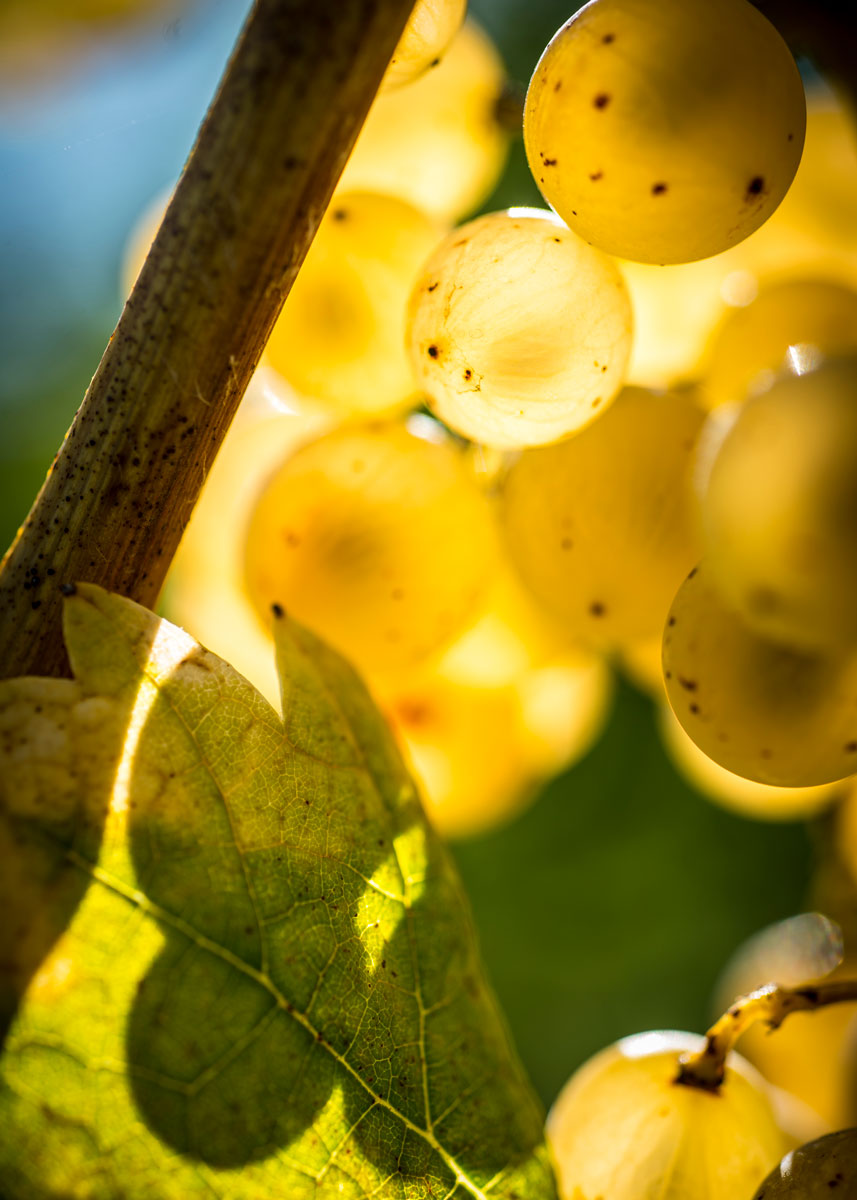
The Basics:
Cognac is a type of Brandy named for the town of Cognac in France. The easiest way to explain it would be all Cognacs are Brandy, but not all Brandies are Cognac. It must fit strict criteria to be a Cognac rather than a Brandy:
- It must hail from the Cognac AOC (Appellation d’Origine Contrôlée). Just as wines labelled Champagne must be from the Champagne AOC. Source of origin and locality is everything to French winemakers, and this extends to Cognac, too.
- It must be made from a specified grape variety (majoritively Ugni Blanc), that has been distilled twice in special copper alembic stills. The designs of such stills are – you guessed it – controlled by law.
- Once the distillation process has occurred, it must be aged for a minimum of two years in Limousin oak casks.
The Appellations:
If you’re familiar with French wine, you will be familiar with appellations and the great impact they have on winemaking. The AOC system was formally introduced in the early 20th century when the Law for the Protection of the Place of Origin was passed. This was to guarantee the authenticity and quality of a product.
They are, in Layman’s terms, specific geographic areas wherein each area has its own set of strict rules that are enforced by law and overseen by a specially appointed government bureau (they take reputation very seriously!). If you don’t follow the rules, you don’t get to use the prestigious label name.
There are seven growing regions or ‘departments’ within the Cognac AOC, sometimes referred to as ‘Cru’. There are two major players, of whom have (arguably) the highest reputation – Grande Champagne and Petite Champagne. (Side note: these have nothing to do with the sparkling cuvées that are synonymous with the name). The other five are Borderies, Fins Bois, Bons Bois, Bois Ordinaires and Bois à Terroirs.
Cognacs hailing from the Grande Champagne department of the AOC are considered by some to be the cream of the crop, followed closely by Petite Champagne. If a Cognac is comprised of a blend of these two designations it can be labelled as ‘Fine Champagne’ so long as the portion of Grande Champagne Cognac is 50% or more. Both areas boast shallow clay-limestone, over limestone and chalk.
The Labelling System:
One of the most frequently asked questions about Cognac is “what’s with the labelling system?” There are V’s and S’s and X’s aplenty – which can lead to a lot of head scratching for anyone who isn’t familiar with Cognac and all its intricacies. The good news is, there’s really only four designations of which you need to remember. VS, VSOP, XO and Hors d’âge, and each of them are an indication of age.
- VS: has been aged for a minimum of 2 years. VS stands for “Very Special” and can sometimes be represented as three stars.
- VSOP: Guarantees at least 4 years of aging. VSOP stands for “Very Superior Old Pale” or “Reserve”.
- XO: Until 2018, XO meant a wine was aged for 6 years. It now represents an aging time of 10 years, and the designation “Napoléon” will step in as the label for any brandies aged for 6 years. XO stands for “Extra Old”.
- Hors d’âge: or “Beyond Age”. To be labelled Hors d’âge, the Cognac fits the criteria of an XO, but the term Hors d’âge is often used to differentiate Cognacs that represent an even higher level of quality than an XO.
The best bit about these Cognacs is that the label given to a Cognac is determined by the age of the absolute youngest brandy used in the blending. Even in a VS brandy it is possible that some of the blend comes from barrels aged for decades.
Introducing Hine Cognac…
Our little corner of the world of Cognac rests with Hine. While it isn’t quite one of the big wigs like Rémy Martin or Hennessy, it isn’t a small name and definitely shouldn’t be passed by. Hine was awarded the Royal Warrant in 1962 by Her Majesty the Queen Elizabeth II, and remains the only official supplier of cognac to the British monarchy. Honestly, if it’s good enough for royalty, it’s good enough for us, but its praises don’t end there.
In 1791, Thomas Hine set out from his home in Dorset, England to learn the ins and outs of how Cognac was produced. He was a mere sixteen years old and curious about what went into creating the copper-tinted brandy his father favoured. His timing, however, was most unfortunate as he reached France right in the middle of the French Revolution – not the safest place for an Englishman at the time by any stretch of the imagination. After turning on his heels and attempting to high-tail it out of there, he was imprisoned at the Château de Jarnac. In a strange twist of events, he marries the daughter of the hosts – Françoise-Elisabeth – and in 1817 he retrospectively gave his name to the house which had been established on the banks of the Charente in 1763, before he’d even been born.
Since then, the descendents of Thomas and Françoise-Elisabeth have maintained the Hine Cognac House, and six generations have upheld its prestige. They are proud of the fact their cellar door has seen many a year pass by – all whilst being tended by the Hines. Today, Bernard Hine is at the helm.
The House of Hine cherishes a solid belief: that a great cognac is above all a great white wine.
“The identity of this wine is imprinted beneath our feet, at the heart of a living land that has evolved over thousands of years. Vines form the link between the earth and the heavens, replete with vagaries and caprices. They infuse the grapes with a character extracted from this unique, unparalleled place, imbued with a temporality that commands the here and now. Cognac embodies a perpetual quest for balance between consistency and virtuosity.”
And it was this philosophy that reeled us at Dhall & Nash in – hook line and sinker. We pride ourselves on our deep respect for the families who work their piece of earth until they know it as instinctively as the back of their hand – it etches itself into the bloodline, and to find this reflected so perfectly in the Hine belief was something that spoke to us all. Add to this the admirable way they’ve maintained a real essence of ‘cool’ that keeps up with modern times and remains approachable and fun, whilst marrying this with a real seriousness and respect for tradition and history. It’s rare for a brand to transcend these rather demographic-defining boxes and become a voice for both new generations of cognac-lovers and loyal veterans of the prestigious tipple.
As well as our word, and that of Her Majesty the Queen, there are plenty of critics who sing the praises of this House as well. Jason Wilson for Vinous recently published a piece detailing his love and exploration of Cognac. In this he says,
“…For this report, I’ve pushed beyond the Big Four, beyond the flashy and expensive, and tried to bring you a broad sense of what’s really happening in Cognac. I have covered more than 50 brands and offering reviews and ratings on more than 200 bottles.
I found value and quality among medium-sized producers like Frapin, Hine, Braastad-Tiffon, Pierre Ferrand, Delamain and Bache Gabrielsen, among others.“
The Guardian, too, listed it among the top ten distillers, tours and tastings.
All in all, Hine is the best of not just both worlds – but every world. It is a wine, it is a spirit, and it’s good at being both. It is a fresh, bold and slightly cheeky brand, yet remains serious and true to its origins going back centuries. Whether you’re young, old, a whiskey-lover, or a wine-aficionado, an ‘on the rocks’ fella or you like it with a twist – Hine’s got you covered.
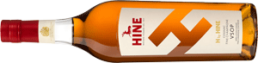
H by Hine VSOP Cognac
“H by Hine is light amber, with a pretty nose of iris and buttered brioche. On the palate, it’s light and fresh, offering notes of nougat and candied orange, and some wood on the finish.”
Antonio Galloni, Vinous (92 points)
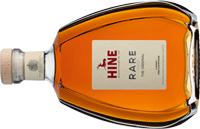
Hine Rare VSOP Cognac
“This rich, supple Cognac is a liquid expression of a vintage leather club chair. The nut-brown spirit has big aromas of crème brûlée, toffee, cigar tobacco and cocoa. After an initial sweetness on the tongue, it finishes relatively dry with lingering caramel, raisin, leather and orange peel flavors, and a bracing alcohol bite.”
Wine Enthusiast (93 points)
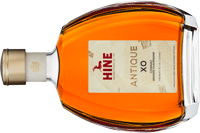
Hine Antique XO Cognac
“Light copper in color, with a subtle nose redolent of fresh flowers at first, but as it opens there are more expressive notes of fruit pastry, which carry on to the full-bodied palate. Pear tart, hazelnuts and a bit of spice and tobacco on the finish.”
Antonio Galloni, Vinous (93 points)